Deep guides
Implementation detail with trade-offs and operational context.
Production-grade AWS and platform engineering notes
InfraTales publishes deep technical guides, architecture teardowns, cost analyses, and failure-driven lessons for engineers and technical leaders building real systems on AWS.
Built for cloud architects, senior engineers, platform teams, and technical founders who need trade-offs, cost realities, and operational clarity instead of demo-level walkthroughs.
Implementation detail with trade-offs and operational context.
Reusable system shapes, not diagram theater.
Where production systems break and what decisions actually hold up.
Most AWS content falls into two categories. There's the official documentation - technically complete but impossible to use for decision-making. And there's the blog/YouTube content - easy to follow but stops the moment things get real. "It deployed!" Great. Now what happens when traffic spikes, the cert expires, and your on-call engineer can't find the runbook?
InfraTales covers the gap. Every article starts with a real infrastructure problem, walks through the architecture decisions that solve it, and doesn't stop until you understand the failure modes, the cost, and the operational reality. Written by one person (Rahul Ladumor, not a content team), based on 9+ years of building production AWS systems for startups and enterprises.
What you won't find here: demo-level walkthroughs, "it depends" answers with no recommendation, vendor-neutral fence-sitting, or content written to hit a publishing calendar. If it's on InfraTales, it's because it's useful - not because it was Tuesday and we needed to post something.
Read these first
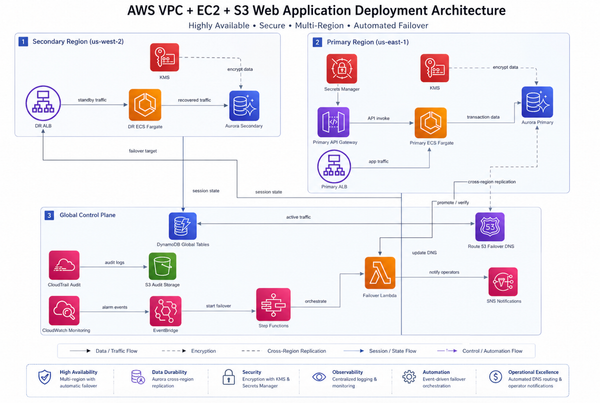
Running dev, staging, and prod on separate VPCs sounds clean until you need them to talk — and your Aurora failover has never actually been tested. This post walks through a real CDK TypeScript stack wiring Transit Gateway, Aurora Global Database, ECS Fargate, and Global Accelerator across three env
Most AWS accounts get hardened once by someone who no longer works there. This post walks through a CDK TypeScript stack that encodes VPC isolation, KMS key policies, IAM least-privilege, AWS Config rules, WAF, and CloudTrail into version-controlled, PR-reviewable infrastructure — so your security p
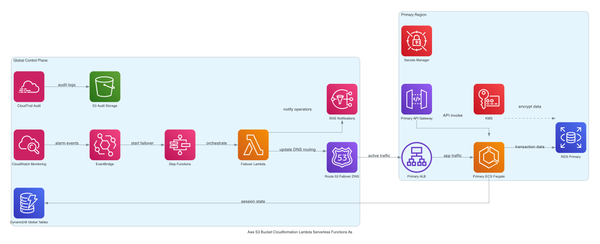
Most S3-to-Lambda setups skip CloudTrail data events entirely and pay for it later with brittle fan-out and zero audit trail. This post walks through a CDK TypeScript stack that routes S3 events through EventBridge properly — VPC placement, KMS encryption, Secrets Manager, cost model, and the failur
Wiring CodePipeline, CodeDeploy, and Auto Scaling in CDK sounds straightforward until your first real scale event cracks the deployment. This post walks the full architecture - VPC, ALB, ASG, SSM config, and the lifecycle hook settings that keep deploys clean under load.
Most CDK tutorials stop at 'it deployed.' This one covers the full aws cdk web application deployment stack - VPC isolation, Fargate on private subnets, Aurora with KMS, CloudFront, Secrets Manager rotation - and the six operational gaps that will wake you up at 2am if you skip them.
Your IAM permissions are a wiki page nobody trusts. This post walks through a CDK TypeScript stack that encodes KMS encryption, IAM roles, and RDS storage security as versioned, reviewable code - and covers the operational traps most tutorials skip entirely.
Core publication areas
Start with the six most useful technical entry points, then move to the full topic directory if you need the wider taxonomy.
Architecture decisions, service boundaries, and production patterns for building on AWS.
Delivery systemsDeveloper platforms, deployment workflows, infrastructure as code, and the mechanics that keep teams shipping.
AI infrastructure — coming soonProduction AI infrastructure, model-serving trade-offs, vector systems, and the operational realities around LLM workloads.
ResilienceIAM, failure isolation, recovery planning, defensive controls, and reliability work that survives the first incident.
Visibility — coming soonMonitoring, logging, alerting, on-call ergonomics, and how to make systems legible under stress.
EfficiencyFinOps, savings trade-offs, architecture-driven spend reduction, and the places optimization breaks production.
Architecture patterns
Pattern articles are where InfraTales turns architecture diagrams, trade-offs, and implementation detail into reusable decision support.
Running dev, staging, and prod on separate VPCs sounds clean until you need them to talk — and your Aurora failover has never actually been tested. This post walks through a real CDK TypeScript stack wiring Transit Gateway, Aurora Global Database, ECS Fargate, and Global Accelerator across three env
Most AWS accounts get hardened once by someone who no longer works there. This post walks through a CDK TypeScript stack that encodes VPC isolation, KMS key policies, IAM least-privilege, AWS Config rules, WAF, and CloudTrail into version-controlled, PR-reviewable infrastructure — so your security p
Practical resources
Resources are built to help readers act on what they just learned, not to pad an email list.
Use it before a design review or migration decision to pressure-test assumptions around scale, blast radius, and operational fit.
Use this before any design review, migration decision, or system audit. It covers VPC design, IAM boundaries, data flow, failure modes, cost posture, and operational readiness.
Browse architecturesA working list for reliability, observability, cost, recovery, and security controls that should exist before traffic makes the decision for you.
Run through this before any production launch or major deploy. Covers reliability, observability, cost controls, recovery procedures, and security baseline.
Start hereMap your biggest spend drivers to the architectural decisions creating them, then decide what should actually be changed first.
Start here when your AWS bill is growing faster than your traffic. Maps spend to architecture decisions so you fix the cause, not just the symptoms.
Cost guidesA starting point for logs, metrics, traces, ownership, alert fatigue, and incident-debugging workflows that do not collapse under load.
Use this to evaluate whether your monitoring, logging, and alerting actually help during an incident - or just generate noise.
Reliability guidesDownload or bookmark the resource. Open it alongside your system's architecture diagram. Work through each section for your specific setup. The goal isn't to check every box - it's to find the gaps you didn't know existed.
Most teams find 3-5 things they'd missed. That's normal. The value isn't in perfection - it's in surfacing the risks before they surface themselves at 2am on a Saturday.
Consulting
InfraTales also does focused consulting for teams that need judgment, trade-off clarity, and production experience instead of generic implementation capacity.